
Assignment: The idea of this site-specific event is to show up in a public space, and dance “without being noticed”. What is dance? Who does it where, when? Can it be “spotted” when it is happening? What do you learn about yourself as a mover/choreographer with this filter? Were there additional prompts, scores of improvisational structures that you gave yourself? In advance? In the moment?
Here is a link to Celeste’s “secret dances in public spaces” exploration from several years ago:
Post about your exploration here. Include video, photo, text, drawings as you see fit.
Secret dances // Nolan Schoenle
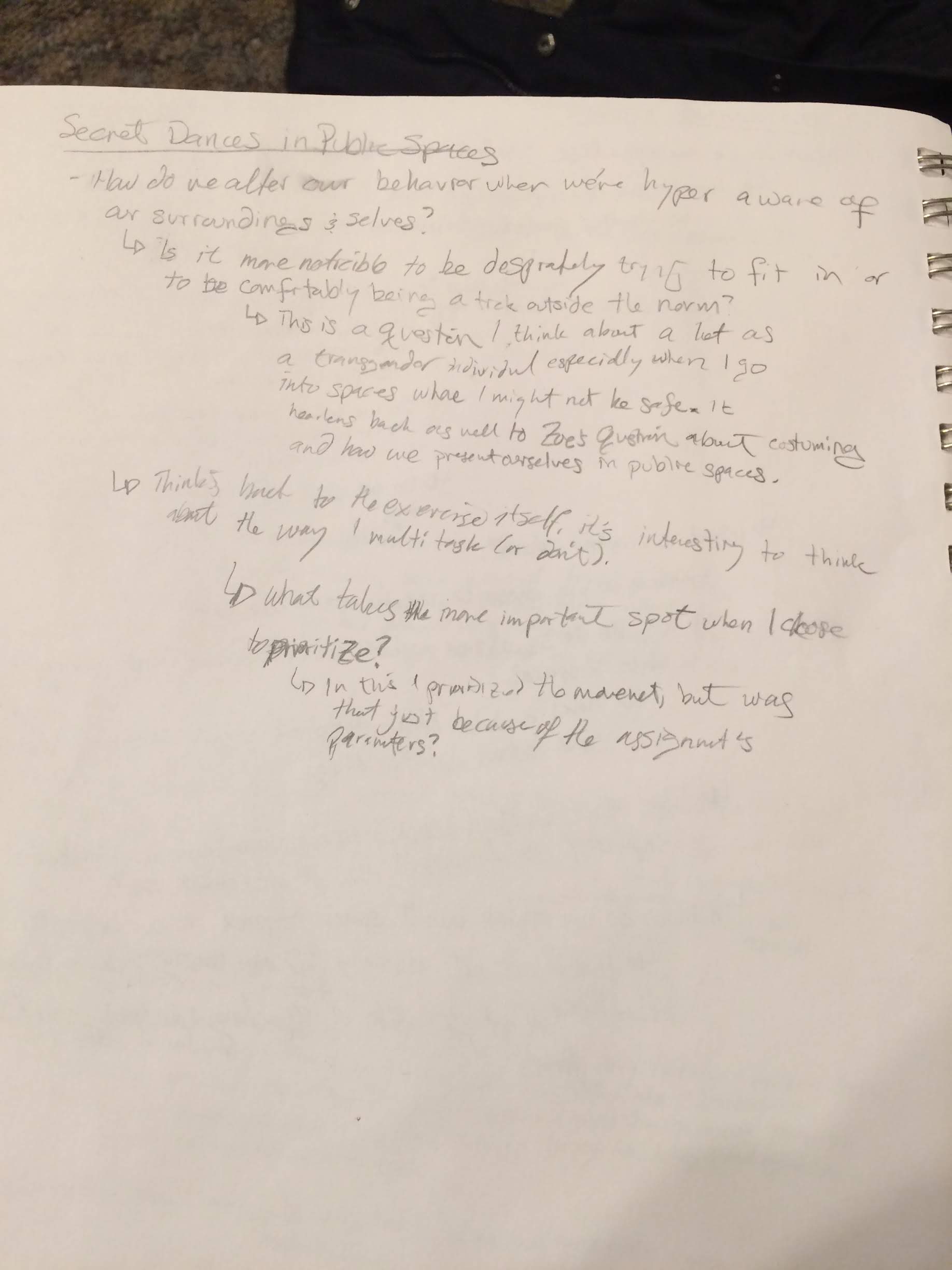
Secret Dances // Kaya Prasad
Talking with Nolan S. >> sometimes used words as an excuse to make movement; other times said things I wanted to say anyway and made intentional movements that fit, or that added irony/changed meaning of words
Played with site-specificity by incorporating rhythms from the site, from moving objects or from sounds around me
Trying to avoid being noticed brings up interesting thoughts; is it more about being surreptitious about making movements that don’t necessarily fit in the site, or more about learning what kinds of movements do fit?
Secret Dances // Jacob Leder
Kept having to remind myself to “dance,” constantly concerned that I wasn’t committed enough to the activity. It became a bit easier when I began speaking with Naomi, and I was able to think about my movements in the context of the conversation.
By Celeste’s definition of dance, even at the most subtle moments, I was dancing. There was always a significant level of awareness with my movement, and nearly all of it was intentional. I wonder if it is possible to shut off one of these elements and still keep the other. If I am aware of my movements, are they not by nature also intentional? I am leaning towards the belief that the two are inextricable.
Secret Dances // Nolan Boggess
I first thought about what does it mean for me to secretly dance in this space. I became super aware of myself, a college student, in a location in the town doing some secret action. In doing this secret dance I began to think about someone from the community coming to Grinnell and doing a secret dance in the library. What does that mean?
Overall, I was surprised at how easy the exercise was. I thought I was going to have to be some sort of spy to ensure my secrecy was maintained. I had a real fun time figuring out what movements were too much, too little, and just right. Yet the thought remained in my head as I was dancing – how are stakes raised based on the place your dancing?
Secret Dances // Jin Chang
Secret dances are not for an audience. The goal is not to be noticed after all. In this vein, I cannot help but think about which bodies are allowed to not get noticed. Would I as an Asian body be able to do a “secret” dance in a predominately white space? People of color constantly live under the white gaze. This gaze makes us all too aware of our movement at all times. From this perspective, our dance is to survive. It is the “dance” around oppressive systems. It is a luxury to be able to dance in secret — to not be noticed. I will have to try this same exercise in a space such as the Asian American Association to see if the lessons learned differ.
Secret Dances// Anjali Jain
Something about secret dances reminds me of that philosophical question “If a tree falls in a forest…”. If someone dances without an audience, have they even danced? The answer is, of course, dance doesn’t have to be for an audience. Then I have to wonder, what is an audience? Is it always necessarily people who watch a performed show, or can it just be a dependency/relationship between dancer and non-dancer? Did secret dances have an audience, because keeping dances “secret” required not being observed?
Secret Dances // Naomi Worob

